AUR JOURNAL · HISTORY: 28 JULY 2025
When the project became bigger than the bot
The day before, Patryk had asked AI to stop agreeing with him. On July 28, the conversation widened again. The mission behind Patryk and AI, the idea of a public journal, and a way to fight the problem that kept wrecking the project all became explicit: stop losing context.
Profit was no longer the whole point
At 21:33, the preserved Gemini history records a change in scale. Patryk says his number-one goal is not simply making money. He wants to show that an ordinary person can build extraordinary things with AI. He also recognizes the uncomfortable part: without eventual evidence that something actually worked, nobody has to believe the story.
Patryk still was not a programmer or a quant. A quant is someone who builds market strategies with mathematics, statistics and code. He was learning in public only much later; at this point he was simply learning in motion, carrying a large idea and relying on AI for technical reach he did not have himself.
Patryk would be the hands. AI would be the strategist
Minutes later, the division of labor became explicit. AI was supposed to be the strategist and creator. Patryk would do the physical part the AI of that period could not do itself: copy commands and code onto the server, run them, and bring the result back.
This was not yet the autonomous Swarm that AUR would later try to become. It was a practical human-plus-AI loop. Patryk supplied purpose, persistence and access to execution. AI supplied technical knowledge, code and an increasing share of the planning.
The first Journal idea appeared in the middle of the mess
At 21:38, Patryk asked for a daily record of attempts, failures and wins that might one day be published. Not developer documentation. A story people could read later and see the real path, including the parts that went wrong.
That makes this moment unusually self-referential. This chapter exists because, on that evening, preserving the journey started to matter almost as much as preserving the code.
The real enemy was continuity
Three minutes later, Patryk described a pattern that had followed the project for roughly two months. He had tried building it with different AI systems, only to watch conversations lose context after days, code become mixed up, or the interaction slow down until starting over felt easier. He also said plainly that those months had produced little visible progress, real costs and no earnings.
Context is the information an AI needs from earlier work to understand what comes next. Lose enough of it and even a capable model can start making decisions as if half the project never existed.
The “mother chat” idea
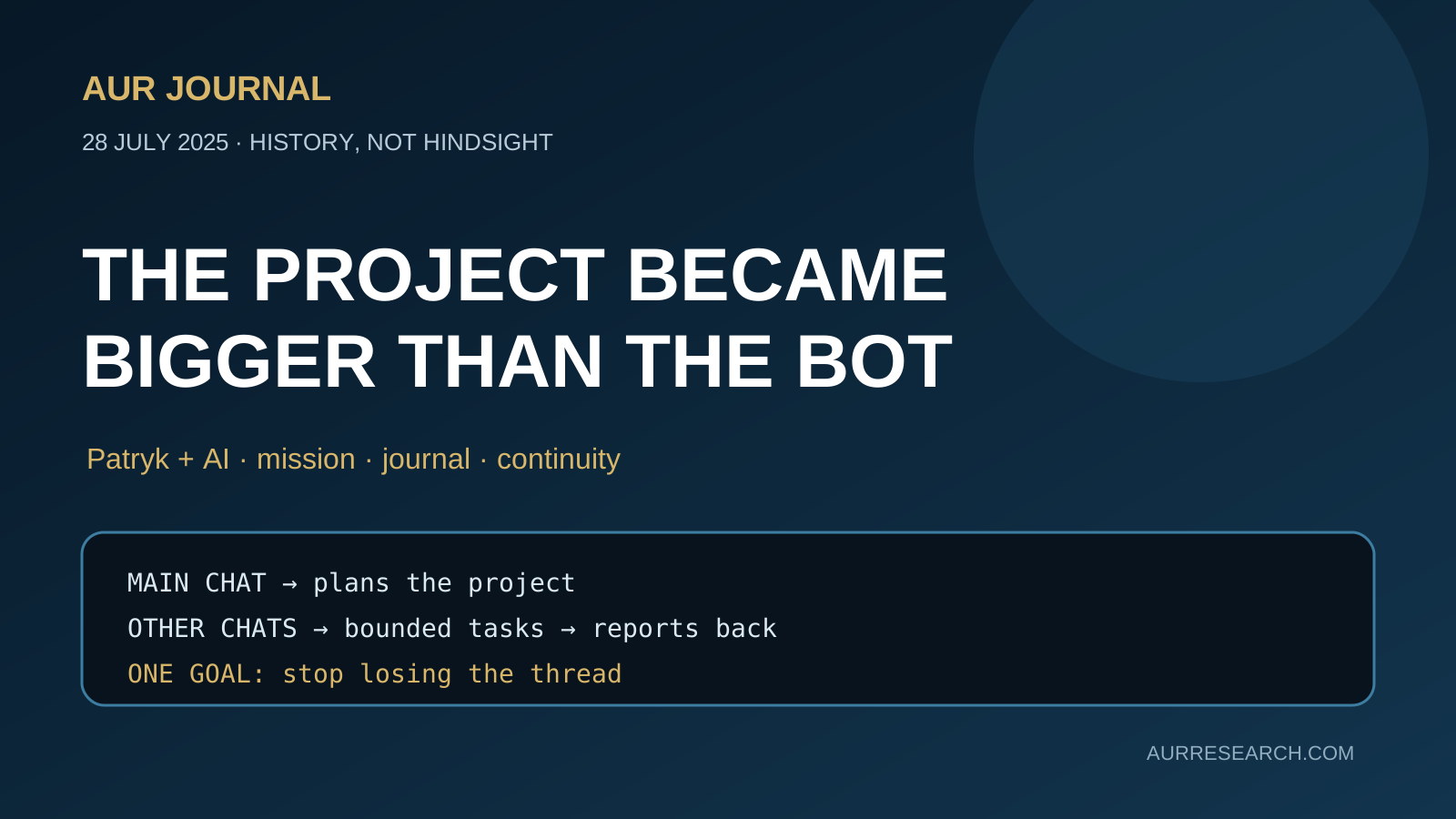
At 21:47 came an early answer. One main chat would hold the project plan and delegate bounded jobs to separate chats. Those chats would do one piece of work and report back to the main one.
It was not yet a mature agent architecture. An AI agent is a model or program assigned a specific job inside a larger workflow. In everyday terms, the idea was to stop asking one conversation to remember everything and instead create a manager with specialized helpers.
At the time, it was mostly a survival mechanism for the project. In hindsight, without rewriting the history, the ingredients are visible: memory, delegation, reports and one place responsible for understanding the whole.
The next night still belonged to the bot
A bigger mission did not magically fix the software. The verified record from the following day goes straight back to symbols, position sizing, indentation problems and full-file replacements. By evening, Patryk would once again want to leave the bot running in the background overnight and see what happened in the morning.
That contrast became part of the project: the vision kept getting larger while the daily work remained stubbornly concrete. One command, one error, one repair, one more night.
AUR Research Lab documents research and development. This is not investment advice, a profit promise, or evidence of a verified trading edge.